Software products
Let customers use product capabilities from their preferred MCP-compatible agent while your product keeps the contract, permissions, and domain rules.
A customer should not have to adopt your proprietary agent to use a valuable product capability. An internal team should not have to rebuild the same process when it moves between agent clients. Both need the domain action to remain independent of the interface that invokes it.
Invokta is the TypeScript framework for building agent-ready software around Action Engines: versioned, headless capabilities that MCP-compatible agents, applications, CLIs, and automations can invoke. Headless means the capability is callable without forcing the user through your UI.
For example, a calendar API can create an event. An Appointment Scheduling
Engine can expose appointments.schedule, check authorization and clinic rules,
revalidate a slot, write through the authorized calendar connector, and return
either a confirmation or a stable conflict.
Users keep their preferred agent while your product continues to own the action’s contract, tools, data access, validation, and result.
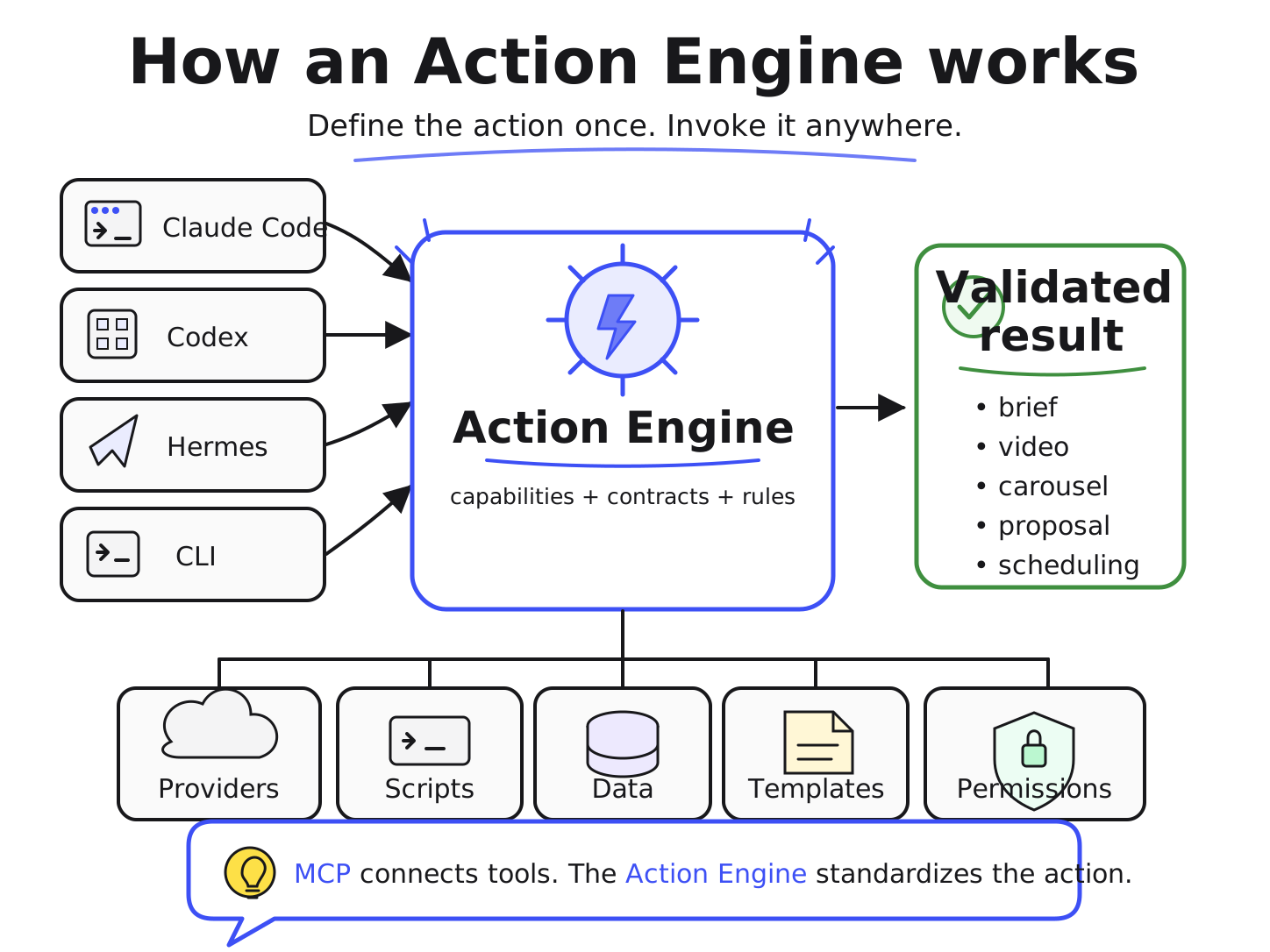
Several example consumers invoke the same domain action. Changing the agent or interface does not rebuild its providers, scripts, data, templates, permissions, contracts, or rules.
A useful product capability or internal process often begins inside one UI, agent configuration, prompt, or skill. The next agent or application receives another copy of its tools, instructions, permissions, validation, and error handling.
Preparing a ticket for implementation, for example, may require intent from Linear or Jira, repository context, architecture decisions, Figma designs, and internal engineering rules. Without an owned action, every harness receives the same tool setup and another copy of the instructions:
Cursor -> Linear MCP + GitHub MCP + Figma MCP + planning skillClaude Code -> Linear MCP + GitHub MCP + Figma MCP + copied skillCodex -> the same setup + another version of the instructionsThe first setup ships quickly. The copies then drift: tools are called differently, permissions and validation change, and each agent may produce a different result.
Invokta turns that process into one reusable action:
Cursor ───────┐Claude Code ──┤Codex ────────┤CLI ──────────┼──> engineering.prepare-implementationApplication ──┘ | ├── ticket intent ├── repository context ├── architecture ├── design ├── engineering rules └── implementation-ready briefThe action owns its integrations, rules, permissions, validation, and output contract. Every consumer reaches the same implementation through application code, the CLI, MCP stdio, or stateless MCP Streamable HTTP.
The same boundary applies whenever a team repeatedly reconstructs context, provider calls, scripts, templates, rules, and expected output for different agents or applications.
Software products
Let customers use product capabilities from their preferred MCP-compatible agent while your product keeps the contract, permissions, and domain rules.
Content and creative
Build a Video Production Engine around ElevenLabs STT, Cartesia TTS, GPT Image 2.0, Seedance 2.0, and trusted editing scripts—or a Social Carousel Engine that already knows your formats, CTA policy, and visual system.
Engineering
Turn a ticket into implementation-ready work with repository context, architecture, design, risks, acceptance criteria, and a test strategy.
Marketing
Turn a product launch into an on-brand campaign using positioning, audience research, approved evidence, previous performance, and channel rules.
Sales
Generate a customer-specific commercial proposal from CRM context while preserving the approved template, visual identity, pricing, and claims.
Healthcare operations
List clinic-approved appointment slots, revalidate the selected time, and write the confirmed appointment through an authorized Google Calendar adapter.
People and recruiting
Apply an explicit job rubric, persist screening evidence in the recruiting system, and notify the hiring team in Slack when human review is warranted.
Explore use cases by company area
An Action Engine packages an AI-supported domain outcome behind a stable contract, independently of the agents, applications, and interfaces that invoke it.
The implementation-ready brief, rendered video, approved carousel, commercial proposal, booked appointment, or screening result is the durable asset. MCP, CLI, HTTP, and direct APIs are delivery paths to that asset. Models, prompts, providers, scripts, templates, and interfaces can change while consumers continue to request the same outcome.
Define a capability once with its input, output, access rule, and execution behavior. Invokta applies the same invocation pipeline from application code, the CLI, MCP stdio, and stateless MCP Streamable HTTP.
Stable contracts
Validate input and output at runtime and publish the same schema information through every adapter.
One execution path
Every adapter calls engine.invoke, keeping validation, authorization,
cancellation, errors, and events in one pipeline.
Delivery paths
Invoke the engine directly, expose a local CLI, or publish MCP tools over stdio and bounded stateless HTTP.
Supporting tools
Check capability composition, install engines in supported local MCP clients, and prepare reviewable HTTP deployment artifacts.
import { createEngine, defineCapability } from "@invokta/core";import { z } from "zod";
const greet = defineCapability({  description: "Create a welcome message for a new team member.",  input: z.object({ name: z.string().trim().min(1) }),  output: z.object({ message: z.string() }),  access: "public",  async run({ input }) {    return { message: `Welcome, ${input.name}!` };  },});
export const engine = createEngine({  name: "hello-engine",  version: "1.0.0",  capabilities: {    "onboarding.create-welcome-message": greet,  },});
The capability ID belongs to the engine map. The capability contains the contract and implementation that every entry point reuses.
Build the complete example
Find a company use case
Browse use cases by company area and identify an outcome that your agents or applications repeatedly reconstruct today.
Explore complete engines
Browse example engines for specifications, context retrieval, code review, image production, observability, and support operations.
Follow a practical recipe
Use a runnable recipe for dependency injection, domain authorization, capability composition, or an external provider.
Understand the boundary
Read about Action Engines and the capability contract.
Look up the API
Use the @invokta/core reference and the
error taxonomy while implementing an engine.